
Hotels today operate in an increasingly competitive hospitality landscape where delivering exceptional guest experiences is just as important as maintaining operational excellence. As guest expectations continue to evolve, hotel owners and management teams need objective ways to measure service quality, identify operational gaps, and ensure consistent brand delivery across every department.
Two of the most effective quality assurance approaches are Mystery Shopping Services and Hotel Mystery Audits. Although these terms are often used interchangeably, they serve different purposes. Mystery shopping services typically focus on evaluating specific customer interactions or service touchpoints, whereas Hotel Mystery Audits provide a comprehensive assessment of the entire guest journey—from reservations and arrival to housekeeping, dining, concierge services, and checkout.
Understanding the differences between these evaluation methods helps hotels choose the right solution based on their operational goals, guest experience strategy, and brand standards. In this guide, we’ll compare Mystery Shopping Services vs Hotel Mystery Audits to help hospitality businesses determine which approach delivers the greatest value.
Related Reading
→ Hotel Mystery Shopping Services: Complete Guide for hospitality-brands
→ Hotel Mystery Audit Checklist: 150+ Points Every Hotel Should Measure
Definitions
Mystery Shopping Services generally evaluate specific customer interactions through trained anonymous evaluators. These assessments focus on individual departments, customer service quality, employee behaviour, and predefined operational touchpoints.
Hotel Mystery Audits take a much broader approach by evaluating the complete guest experience while measuring compliance with brand standards, standard operating procedures (SOPs), and operational performance across multiple hotel departments.
Unlike traditional mystery shopping, hotel mystery audits provide management with detailed operational insights, actionable recommendations, and department-level performance analysis that support long-term quality improvement.
Related Reading
→ Top Hotel Mystery Shop Companies: How to Choose the Right Partner
Comparison Table
| Category | Mystery Shopping Services | Hotel Mystery Audits |
| Primary Objective | Evaluate customer interactions | Evaluate complete hotel operations and guest journey |
| Scope | Specific touchpoints | Multi-department assessment |
| Departments | Usually limited | Front office, housekeeping, F&B, concierge, spa, checkout and more |
| Reporting | Service observations | Detailed operational analysis with recommendations |
| Best For | Service quality checks | Continuous quality assurance and brand consistency |
Need a complete operational assessment?
Explore how Hotel Mystery Audits evaluate every stage of the guest journey beyond traditional mystery shopping services.
Business Use Cases
Different hospitality businesses have different evaluation requirements.
Mystery Shopping Services are ideal for:
- Restaurants
- Front Desk Evaluations
- Reservation Teams
- Sales Teams
- Retail Outlets
- Individual Guest Interactions
Hotel Mystery Audits are ideal for:
- Luxury Hotels
- Resorts
- Boutique Hotels
- Serviced Apartments
- Casino Hotels
- Mixed-use Hospitality Developments
- Multi-property Hotel Groups
Because they evaluate the complete guest journey, hotel mystery audits provide a deeper understanding of operational performance while identifying opportunities to improve service quality, guest satisfaction, and brand consistency.
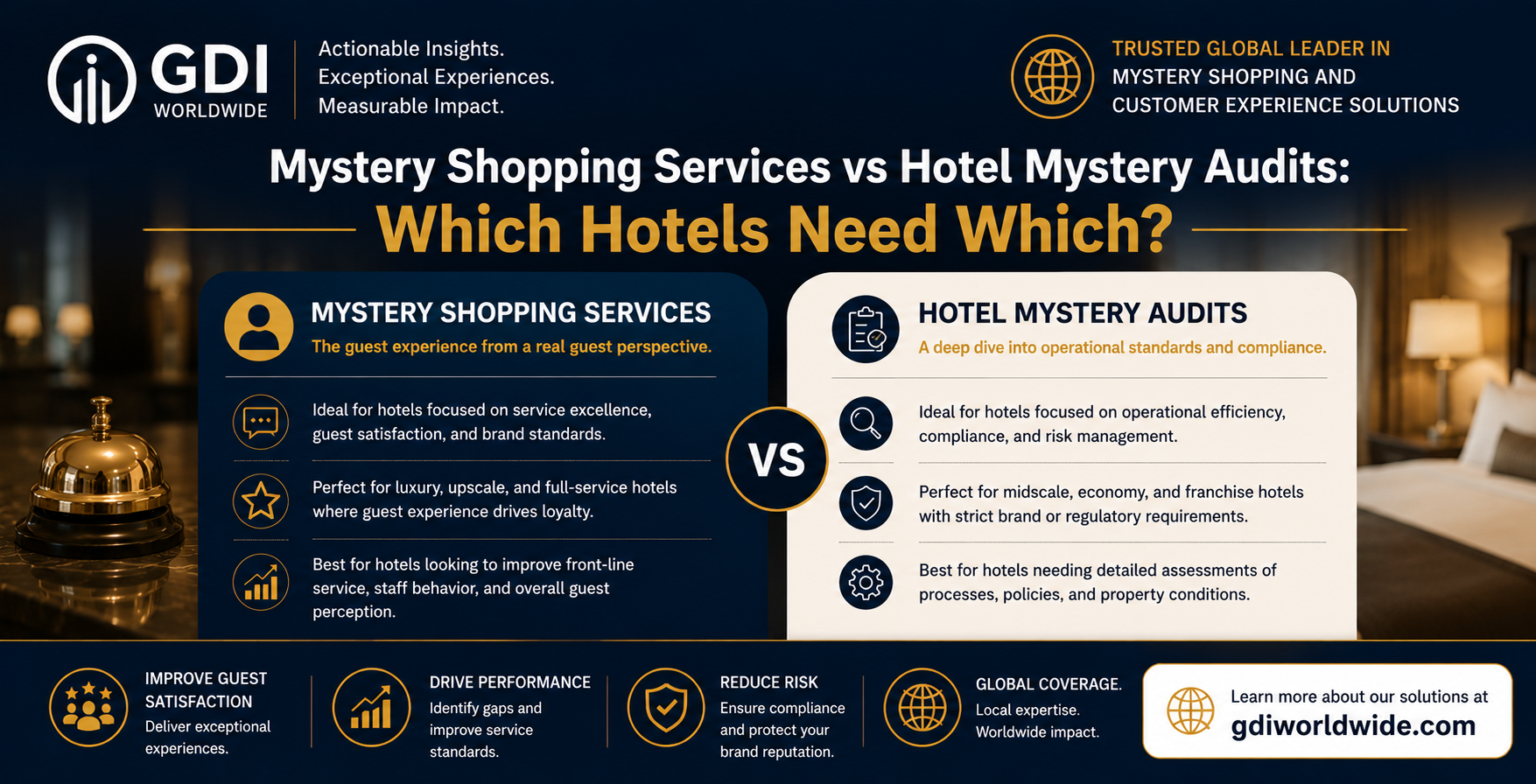
Which Hotels Need Which?
Smaller independent hotels may benefit from targeted Mystery Shopping Services when evaluating individual departments or customer interactions.
However, luxury hotels, international brands, serviced apartments, resorts, and hotel management companies typically require Hotel Mystery Audits that evaluate every guest touchpoint and operational process.
At GDI Worldwide, every Mystery Audit is customized according to:
- Hotel Category
- Brand Standards
- Operational Objectives
- Guest Expectations
- Department Structure
- Quality KPIs
This ensures management receives practical recommendations that support continuous improvement.
Related Reading
→ Hotel Mystery Audit Complete Guide
Cost Comparison
The investment required depends on several factors, including property size, operational complexity, evaluation scope, reporting depth, and geographic coverage.
Targeted Mystery Shopping Services generally involve lower investment because they assess selected guest interactions or departments.
Hotel Mystery Audits, while more comprehensive, deliver greater long-term value by evaluating operational performance across the entire guest journey. They help hotels identify root causes of service issues, prioritize improvements, and strengthen overall business performance.
Rather than viewing cost alone, hotels should evaluate the long-term return generated through improved guest satisfaction, operational efficiency, and stronger brand consistency.
Related Reading
→ ROI of Hotel Mystery Shopping Services
Benefits
Benefits of Mystery Shopping Services
- Measure customer service quality
- Evaluate employee interactions
- Improve reservation performance
- Support departmental training
- Monitor service consistency
Benefits of Hotel Mystery Audits
- Evaluate the complete guest journey
- Improve Guest Satisfaction
- Strengthen Brand Compliance
- Validate SOP Implementation
- Improve Operational Excellence
- Enhance Online Reputation
- Support Employee Development
- Reduce Operational Risks
Hotels that combine both evaluation methods often gain a more comprehensive understanding of overall hospitality performance.
Related Reading
→ How Hotel Mystery Shopping Improves Guest Satisfaction Scores
Conclusion
Choosing between Mystery Shopping Services and Hotel Mystery Audits depends on your hotel’s operational objectives, service standards, and quality assurance strategy. While mystery shopping services are highly effective for evaluating individual customer interactions and departmental performance, hotel mystery audits, on the other hand, provide a comprehensive assessment of the complete guest journey, helping management identify hidden operational gaps that directly influence guest satisfaction and brand reputation.
Rather than viewing these approaches as competing solutions, many successful hospitality businesses integrate both into their continuous improvement strategy. Together, they provide valuable operational insights, strengthen compliance, improve employee performance, and support consistently exceptional guest experiences.
At GDI Worldwide, our customized Hotel Mystery Audits help hotels, resorts, serviced apartments, and hospitality groups evaluate every stage of the guest journey through independent, data-driven assessments. Our actionable recommendations empower management teams to enhance operational excellence, strengthen brand standards, and create memorable guest experiences that drive long-term business success.
Frequently Asked Questions
Are mystery shopping services the same as hotel mystery audits?
No. Hotel mystery audits usually provide a broader evaluation of the guest journey and operational performance.
Which option is better for luxury hotels?
Luxury properties often benefit from comprehensive mystery audits.
Can both services be combined?
Yes. Many hotels combine targeted mystery shopping with periodic mystery audits.
How often should hotels perform audits?
Quarterly or biannually based on operational requirements.
Can GDI Worldwide customise audit programmes?
Yes. Every programme is tailored to the client’s hospitality objectives.
Ready to Improve Your Hotel’s Guest Experience?
Partner with GDI Worldwide for professional Hotel Mystery Audits designed to strengthen service quality, improve operational performance, and deliver measurable improvements across every guest touchpoint.
Contact GDI Worldwide today to discuss a customized Mystery Audit program tailored to your property’s operational goals and brand standards.